
Mary Magdalene and the Forgotten Eastern Tradition
I’ve been down a very long rabbit hole trying to piece together the life of Mary Magdalene.
The New Testament leaves us with a tantalising gap. We know Mary was present at the crucifixion, came to the tomb, and became the first witness to the risen Christ. But after the Resurrection appearances, the Gospels fall silent. What happened to her afterwards?
Most of us have heard the Western Christian story. Mary travelled to Gaul, modern-day southern France, where she became a missionary and preacher, then withdrawing to a cave at Sainte-Baume before her death and burial at Saint-Maximin.
It’s a compelling story. It has inspired centuries of devotion, pilgrimage, art and spiritual imagination. I’ve visited the cave at Sainte-Baume and sat before the relics attributed to Mary at Saint-Maximin. There is something deeply moving about standing in places where generations of people have honoured her.
But as I began following the historical trail, I found something unexpected.
The developed Provençal account appears in surviving written sources many centuries after Mary lived. The Eastern tradition, however, takes us much further back.
To Ephesus, on the western coast of modern Türkiye.
According to Eastern Christian tradition, Mary travelled there to join John the Evangelist. She continued her apostolic life, died, and was buried in Ephesus. Her tomb became a destination for pilgrims, and later Byzantine accounts placed it near the famous Cave of the Seven Sleepers.
What caught my attention was not simply that another tradition existed. It was how early we could trace it, the number of different witnesses who referred to it, and the evidence that pilgrims were still being shown her burial place centuries later.
Could Ephesus be the missing chapter of Mary Magdalene’s life?
I wanted to know how far back this tradition went. So, I started looking for the earliest evidence.
A Sixth-Century Surprise
The first discovery stopped me in my tracks.
The earliest surviving written reference placing Mary Magdalene’s burial in Ephesus comes from Gregory of Tours, a Gallo-Roman bishop who lived from about 538 to 594 CE.
Gregory was a prolific writer about saints, miracles, and relics. His Glory of the Martyrs preserves traditions from across the Christian world, including Gaul, Spain, Italy, North Africa, and the East.
In a short passage describing the sacred history of Ephesus, he mentions Mary Magdalene, the Seven Sleepers, and the destruction of the image of Diana by the apostle Paul.
His statement about Mary is remarkably direct:
“Maria Magdalene in ea civitate sepulta est, nullum super se tegumen habens.”
“Mary Magdalene is buried in that city, having no covering over her.”
Another translation renders the passage:
“Mary Magdalene rests in that city [Ephesus], although there is no building over her. In that city are also the Seven Sleepers … In the same city was the image of Diana that the apostle Paul destroyed.” (Gregory of Tours, Glory of the Martyrs; Krusch 1969, 55; Van Dam 2004, 26–27.)
I found this extraordinary.
Gregory doesn’t present Mary’s burial in Ephesus as a possibility or a newly emerging rumour. He simply states that she is buried there, as though this is an established tradition.
The Latin word tegumen can mean a covering, shelter, or protective structure. Gregory seems to be describing an identifiable burial place, although we cannot be certain exactly what kind of covering he meant.
And there is another intriguing detail. He mentions Mary in the same passage as the Seven Sleepers.
The Cave of the Seven Sleepers
The Seven Sleepers are part of one of the most extraordinary stories to emerge from early Christian Ephesus.
According to the tradition, seven young men took refuge in a cave during the persecution of Emperor Decius, around 249–251 CE. Rather than renounce their faith, they hid from the authorities and miraculously fell asleep. They remained there, miraculously reawakening centuries later.
Two important early versions are the Syriac Story of the Youths of Ephesus and Jacob of Serugh’s Homily on the Youths of Ephesus, written before his death in 521. Neither, as far as I can establish, mentions Mary Magdalene.
Gregory’s account is interesting for another reason. He explains how he obtained the story of the Seven Sleepers, crediting a Syrian interpreter named John who helped translate the Eastern narrative into Latin.
This gives us a glimpse of the movement of stories, people and religious traditions between the Christian East and West.
I wanted to find out whether this was an isolated reference or the beginning of a much longer tradition.
It wasn’t.
A Woman who Remained an Apostle
A more developed account appears in a tradition attributed to Modestus, Patriarch of Jerusalem, who died around 630 CE.
The original work is no longer preserved in its entirety, but extracts survive in the writings of the ninth-century Byzantine scholar Photius, particularly in the Bibliotheca, codex 275, and the Amphilochia, 158.
This account describes Mary as a myrrh-bearer who, after the death of Mary, the mother of Jesus, travels to Ephesus to join the beloved disciple, John.
There, she continues her apostolic life and eventually suffers martyrdom.
The surviving passage says:
“After the death of our Holy Lady, the Mother of God, she went to Ephesus to be with the beloved disciple, and there Mary, the bearer of perfumes, completed through martyrdom her career as an apostle, having not wished, until her last breath, to be separated from John, the evangelist and virgin.”
What struck me was the way Mary is remembered here.
Mary is not simply the woman who witnessed the Resurrection. She is an apostle whose ministry continues until her death. Her journey to Ephesus is presented as an extension of her relationship with John and her commitment to the Christian mission.
This is a very different emphasis from the Western image of Mary as a penitent hermit, withdrawn from the world.
The Eastern tradition remembers Mary as a participant in the early Christian movement, not simply as someone whose story ends at the empty tomb.
Mary is active, faithful, and spiritually authoritative.
And the tradition does not disappear. It begins to leave a trail through the accounts of pilgrims.
Pilgrims to Mary’s tomb
By the eighth century, the Ephesian tradition had become part of the geography of Christian pilgrimage.
In 724, the English pilgrim Willibald travelled through the eastern Mediterranean. His journey was recorded by the nun Hugeburg of Heidenheim in the Itinerarium, also known as the Hodoeporicon.
Willibald visited Ephesus, where he and his companions went to the tomb of John the Evangelist and to the Cave of the Seven Sleepers. His account also refers to Saint Mary Magdalene, “who rests there”.
This account takes us beyond a written theological tradition. We now have a pilgrim account connecting Mary with the actual sacred landscape of Ephesus.
Willibald doesn’t authenticate a tomb or tell us precisely what he saw, but it shows that the Ephesian Magdalene tradition was established enough to form part of an experience already attracting pilgrims.
Willibald’s Hodoeporicon, preserved in the Acta Sanctorum edition, says:
“At the sepulchre of St John the Evangelist, marvelling at the manna bubbling up from it … afterwards they commended themselves to the Seven Sleepers and to Mary Magdalene, resting in the same place.”
The Latin is particularly interesting: Mariae Magdalenae, ibidem quiescentibus.
This means Mary Magdalene is described as resting in the same place. The editor of the Acta Sanctorum explicitly adds a note identifying this as a reference to the burial of Mary Magdalene at Ephesus.
Later Byzantine sources make the connection with the cave more explicit.
The Synaxarion of Constantinople, compiled around the middle of the tenth century, records that Mary went to Ephesus, lived with John, died there and was buried near the Seven Sleepers.
The Menologion of Basil II, compiled around the late tenth or early eleventh century, also preserves the tradition that her tomb was at the entrance to the cave.
I was beginning to see a pattern. This wasn’t simply a passing reference in an old text. For centuries, Mary Magdalene was remembered in Ephesus, and people were travelling there to honour her.
But then another question emerged.
If Mary was buried in Ephesus, what happened to her remains?
Where Were Mary’s Relics?
I started to imagine travelling to Türkiye to sit in the place where Mary’s remains lay.
But it wasn’t that simple.
According to Byzantine tradition, Mary’s remains were transferred from Ephesus to Constantinople during the reign of Emperor Leo VI, who ruled from 886 to 912.
They were placed in the monastery of Saint Lazarus, where they were associated with the remains of Lazarus. The tradition also records the translation of Lazarus’s relics from Cyprus in 898.
Constantinople had become an extraordinary repository of Christian relics. The remains of saints, apostles and biblical figures were central to the city’s religious and political identity.
A late eleventh-century Latin description of Constantinople, sometimes known as the Anonymus Mercati, identifies Mary Magdalene as resting in the monastery of Saint Lazarus, alongside Lazarus himself.
The text also lists Martha and Mary, the sisters of Lazarus, preserving the Eastern distinction between these women and Mary Magdalene. The Eastern tradition did not necessarily conflate Mary Magdalene with Mary of Bethany or make her one of Lazarus’s sisters. It preserved their separate identities.
Yet the Russian pilgrim Antony of Novgorod visited Constantinople around 1200 and although he visited hundreds of relics, he fails mention a visit to Mary’s.
Perhaps Mary was one among many revered figures whose relics were not always included in a pilgrim’s account. Or perhaps the claims surrounding her remains were less straightforward than later writers suggested.
Then I found something even more intriguing.
The Coffin and the Head
Around 1106–1108, another Russian pilgrim, the abbot Daniel, visited Ephesus.
He went to see the tomb of John the Evangelist and the Cave of the Seven Sleepers. His account describes what he was shown inside the cave:
“There is a cave nearby where lie the bodies of seven youths who slept for three hundred and sixty years: under King Decius they fell asleep, and under King Theodosius they appeared. In the same cave, three hundred holy fathers lie; here Saint Alexander lies, and the coffin of Magdalene Mary, and her head; and the holy Apostle Timothy, a disciple of the holy Apostle Paul, lies in an old tomb.”
I had to read that passage twice.
More than two hundred years after the supposed translation of Mary’s remains to Constantinople, a pilgrim was still being shown her coffin and head in Ephesus.
What are we to make of this?
Perhaps the translation to Constantinople did not remove all her remains. Perhaps the Ephesian site retained its identity as Mary’s burial place after important relics had been transferred. Or perhaps Daniel was shown objects venerated as Mary’s remains, but which were not hers.
We cannot know.
But Daniel’s account is significant. In the early twelfth century, pilgrims were still being shown a coffin and a head identified as Mary Magdalene’s in the very landscape where Gregory of Tours had placed her burial centuries earlier.
The Ephesian story was still alive.
Meanwhile, in the West…
While pilgrims were travelling to Ephesus, relics attributed to Mary Magdalene were also finding their way to Western Europe.
Michael McCormick, in Origins of the European Economy, discusses an eighth-century relic associated with Mary Magdalene at the monastery of Chelles, east of Paris. Even more exciting, the relic acquired by the monastery of Chelles was reportedly acquired from Ephesus.
This suggests that the association between Mary Magdalene and Ephesus was not confined to Eastern literary accounts. Relics identified with her were also travelling west from there. And there was a connection between the Eastern tradition and the Frankish world.
Other records follow.
An eleventh-century list from Exeter Cathedral records a gift from Aethelstan, King of the Anglo-Saxons, which included a finger bone of Mary Magdalene. She is identified as the woman who washed Christ’s feet with her tears.
In 1039, relics attributed to Mary were recorded at the Abbey of Saint Willibrord in Echternach, in present-day Luxembourg. An eleventh-century catalogue from Oviedo in Spain listed hair said to have been used to dry the feet of Jesus.
As medieval relic devotion expanded, more churches claimed to possess parts of Mary’s body or objects associated with her life.
Constantinople and the Fourth Crusade
And then came the Fourth Crusade.
In April 1204, crusaders captured and sacked Constantinople. Rather than reaching the Holy Land, the crusading army turned against one of the greatest Christian cities in the world.
Churches and monasteries were stripped of treasures. Sacred objects were carried away, distributed and sold to Western rulers, bishops, monasteries and churches.
The consequences for the movement of relics were enormous.
Bishop Conrad of Halberstadt, who participated in the crusade, is associated with the acquisition of relics attributed to Mary Magdalene, including part of her skull.
A late thirteenth-century inscription at the Lateran in Rome also refers to Mary’s body being buried in an altar, without its head and arm, alongside relics of other saints.
The competing claims were becoming increasingly complicated.
By this time, the Eastern tradition had already provided a history of Mary’s burial in Ephesus and the translation of her remains to Constantinople. The Fourth Crusade created another major episode in the dispersal of relics identified with her.
It is worth remembering that these were not necessarily all parts of one identifiable body. Medieval churches made competing claims, and the provenance of individual relics needs to be examined separately.
The Western Claims
In Provence, Vézelay had long promoted its claim to Magdalene’s relics.
Then, in 1279, Charles II of Anjou sponsored the discovery of a body at Saint-Maximin, near Aix-en-Provence, which was identified as Mary Magdalene.
The discovery was a major event. The body was said to be almost complete, and an inscription was presented as evidence of its identity.
Salimbene de Adam, the Franciscan chronicler, accepted the claim at Saint-Maximin. He even joked about the existence of three bodies of Mary Magdalene!
Relics were not simply devotional treasures. They brought prestige, pilgrims, donations and political influence. The question was no longer just where Mary had been buried. It was also who possessed her.
What is important is the chronology.
The developed Provençal account belongs to the medieval period. Gregory of Tours had already placed Mary’s burial in Ephesus in the sixth century.
Willibald’s pilgrimage account, the Byzantine liturgical tradition and Daniel’s description of her coffin and head provide further evidence of the persistence of the Eastern tradition.
Two Traditions, One Woman
By the later medieval period, writers were trying to bring the Eastern and Western accounts together.
The anonymous Greek Life of Mary Magdalene, composed sometime between the mid-twelfth and late thirteenth centuries, is particularly revealing.
It is a composite narrative that incorporates elements of the Provençal story while ultimately returning Mary to the East.
Mary travels to Rome, confronts the emperor over the execution of Jesus, and continues her missionary journeys through Italy and Gaul. She travels through Phoenicia, Syria and Egypt, returns to Jerusalem, preaches in Pamphylia and eventually reaches Ephesus with John and Mary, the mother of Jesus.
There she dies and is buried in a cave.
Nikephoros Kallistos Xanthopoulos, writing between 1282 and 1328, develops this journey further, also describing the translation of Mary’s remains to Constantinople under Leo VI.
These are late accounts, not contemporary records of Mary’s life. But they reveal that by the medieval period, Eastern writers were weaving together the competing traditions.
Mary could be remembered as a missionary who travelled through Gaul and the Mediterranean, yet whose final home was Ephesus.
The Eastern tradition did not simply disappear beneath the Western story. It continued to shape how Mary was remembered.
Why Ephesus Matters
So where does the evidence leave us?
The developed Provençal story begins to emerge in surviving written sources around the eleventh century.
The Ephesian burial tradition is already recorded by Gregory of Tours in the sixth century.
Gregory’s testimony deserves our attention. He was a bishop living in Gaul, in the very region that would later become central to the Provençal Magdalene tradition. He wrote extensively about saints, relics, and miracles, and drew on accounts and traditions from beyond his own region.
Gregory does not offer us a single legend of places sacred to Mary in Gaul. He states Mary’s burial was in Ephesus.
By the eighth century, pilgrims were visiting Ephesus and remembering Mary there. Byzantine liturgical sources continued to preserve her association with John and the Seven Sleepers. In the early twelfth century, the Russian pilgrim Daniel was still being shown a coffin and a head identified as hers.
And the relic trail extends beyond Ephesus. The reported acquisition of a Mary Magdalene relic from Ephesus by the monastery of Chelles in the eighth century connects the Eastern tradition with the Frankish world.
Taken together, these sources make Ephesus a serious historical candidate for Mary’s final home, and one that deserves far more attention than it has traditionally received in Western accounts of her life.
We can make a much stronger historical observation.
The Eastern Christian tradition that Mary Magdalene was buried in Ephesus is documented centuries before the developed Provençal narrative. This belief continued to be expressed through texts, pilgrimage, and relic traditions over several hundred years.
I feel like my own search has taken me backwards from the Cathars of France back through the supposed life of Mary in a cave in Provence, back to arriving on the coast of Gaul in a rudderless boat.
Now I’ve been taken back much further to beliefs of her relics spread far and wide after the Fourth Crusade, back in Constantinople, backwards to burial in Ephesus, back to her life actively participating in the ministry of Jesus’ followers in Asia Minor.
Back to her life in Ephesus after Mary, mother of Jesus died, to join John in his work.
I find myself standing before the same woman who approached me, hips swinging, joyous, beckoning me to follow her.
The woman I met in Saint Maximin in the crypt with her skull. The woman who spoke to me in the cave of Saint Baume. The woman who reassured me in St Madeleine Church in Paris that her remains being divvied up and spread around was a good thing because her influence rippled out far beyond to impact more people.
I met the Mary Eastern tradition remembers. She is incredibly brave. She is strong in her vulnerability. She is faithful to her cause, to her rabbi. She holds a quiet spiritual authority that means she does not need to raise her voice.
And incredibly, she is active, still drawing people to her two thousand years later.
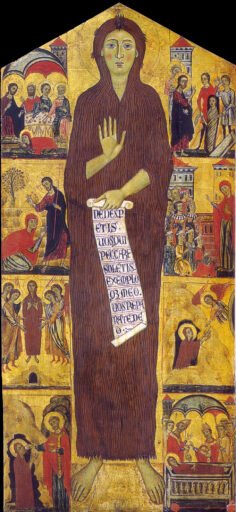
Image: Galleria dell’Accademia, Florence, has one of the earliest icons of MM as penitent. Vita icon c.1280 CE, is the first known depiction of MM as a composite saint with three gospel figures given equal weight (washing Jesus’ feet, raising Lazarus, and her role in resurrection noli me tangere). The scroll in her hand emphasises penance and therefore salvation. It declares MM a symbol of hope for sinners, and an example to be emulated.