
The Five Sacraments
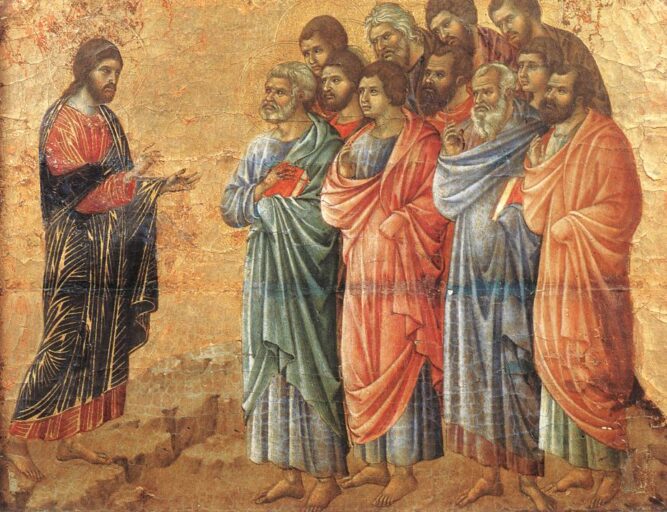
Discovered at Nag Hammadi in 1945, the third century Gnostic text ‘Gospel of Philip’ describes secret initiations and teachings Jesus had given his disciples called the five sacraments.
The ‘Gospel of Philip’ presents a layered sequence of rites with baptism, anointing (chrism), eucharist, redemption, and what it calls the “bridal chamber.” It speaks in symbolic language rather than practical instruction: “The Lord did everything in a mystery: a baptism and a chrism and a eucharist and a redemption and a bridal chamber.” And elsewhere: “Baptism is the ‘Holy Place’… the ‘Holy of Holies’ is the redemption, the ‘Holy of Holies of Holies’ is the bridal chamber.”
This is a theological map, probably from the third century, describing stages of spiritual transformation as understood by a particular Gnostic community. The imagery draws on temple language of outer court, inner sanctuary, and holy of holies reimagines initiation as a movement inward toward union.
Philip described an initiation with five stages to attain a consciousness where the soul is unified with God: “Immersion or Baptism brings one into the Holy Place. Restoration to the Fullness of Being is the Holy of Holies, and the Holiest Place is the Bridal Chamber” (Gospel of Philip saying 44).
There is proof that Jesus’ disciples continued to offer these five sacraments, including tantalising evidence that Mary Magdalene might have performed baptisms, anointings (chrism), evangelised to help others to attain the restoration to fullness of being and was initiated into the bridal chamber…by Jesus.
Early Christian and Gnostic texts preserve a memory of Mary Magdalene as a leading figure in teaching and transmitting insight. Some later traditions imagine women—including a figure named Mariamne—performing baptisms and participating in mission at a high level. Certain Gnostic communities developed a rich, multi-stage initiatory theology that included baptism, anointing, and symbolic union with the divine.
There is solid evidence that early Christians practiced baptism, anointing, and communal meals. You see baptism and laying on of hands in the Acts of the Apostles, and hints of anointing and healing elsewhere. Over time, these develop into what later Christianity calls sacraments.
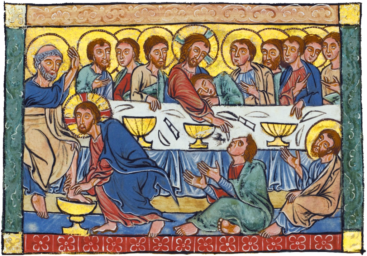
This image of the Last Supper is a miniature from a Psalter from about 1220-40.
The five sacraments listed in the ‘Gospel of Philip’ is mapping stages of spiritual transformation using temple imagery. It’s not describing a documented, standard initiation program used by the historical disciples in the first century. Through this inner process the initiate realised their original state of tri-unity with God, perfected human and their divinity as fully realised humans, anthropos.
Philip was describing an initiation with five stages to attain a consciousness where the soul is unified with God. The five sacraments were Jesus’ method, the practises, and rituals, he used to help an initiate enter a state of anthropos. These rituals work together to bring a person to a state beyond gender, beyond dualities and towards a living spirit that is an enlightened being or completely realised human, anthropos. This gives us a new wider understanding of anointing not just as a healing modality but as the ultimate sacrament.
These rituals work together to bring a person to a state beyond gender, beyond dualities and towards a living spirit that is an enlightened being or completely realised human, anthropos. This gives us a new wider understanding of anointing not just as a healing modality but as the ultimate sacrament for The Way of Love.
The Secret Teachings
 The five sacraments were most likely a secret teaching offered to a select group of initiates. Not even all the disciples were seen as advanced spiritually enough to be initiated fully.
Jesus openly admitted “I disclose my mysteries to those who are worthy of my mysteries.” (‘Gospel of Thomas’ saying 62)
The disciples, particularly Peter, complained that Jesus gave secret teachings to few. Jesus’ simple teachings were for the masses, but his secret teachings were exclusively kept for the high initiates. Jesus’ inner circle held the secrets of initiation.
Mary Magdalene was one of the chosen few.
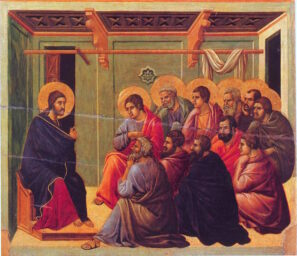
Here, Jesus is giving the Farewell Discourse to his disciples after the Last Supper (John 14–17) from the Maestà by Duccio, 1308–1311.
Jesus openly praised Mary Magdalene for her wisdom. In the ‘Dialogue of the Saviour’, dated between the mid to late second century, Mary Magdalene was described the “woman who knew the All” or who had understood completely.
In the ‘Pistis Sophia’ describes Jesus replying to Miriam (Mary Magdalene) saying:”Miriam, thou blessed one, whom I will complete in all the mysteries of height, speak openly, thou art she whose heart is more directed to the Kingdom of Heaven than all thy brothers.”
This is in contrast with the Orthodox Church that prescribed the way to Kingdom of Heaven is through faith alone or by relying on the scriptures and intellectual methods.
 I can imagine how annoyed the disciples were when they discovered the secret teachings were not being given to them but to a woman. Mary Magdalene loved the tree and its fruit. Mary Magdalene must have understood Jesus’ beliefs on a whole different level. Mary Magdalene seems to have been the only one who understood Jesus better than any other disciples.
The ‘Gospel of Philip’ makes it clear that these initiation rituals are not purely symbolic, insisting: “it is truly imperative that one must not be reborn in symbol only.” (‘Gospel of Philip’ saying 44).
These five sacraments represent the initiations that Jesus used to transmit his core teachings. Most of them are familiar to us and were continued by the Orthodox Church. Others have been vehemently denied, rejected, and ignored.
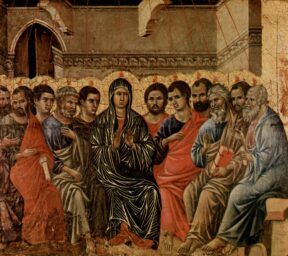
This fresco by Duccio di Buoninsegna is of the Pentecost from about 1308 in the Museo dell’Opera del Duomo in Siena, Italy. The panel is part of the larger Maestà altarpiece, commissioned in 1308 for the Siena Cathedral.
Is there any evidence that Mary Magdalene performed initiations and used the five sacraments? Let’s take a closer look…
1. Baptism
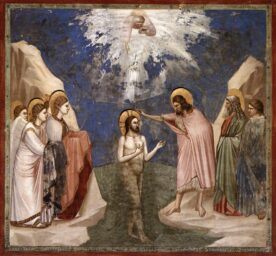 Most of us are pretty familiar with this concept as it continues to be used in churches today.
What we call “baptism” in an Egyptian context is not a single, once-for-all rite in the later Christian sense, but a dense, repeated choreography of water by washing, pouring, immersing woven into temple life, kingship, and daily priestly service. The Nile is always there in the background, not just as a river but as a living axis. To step into its water, or into water drawn from it, is to step into a current that links earth, underworld, and sky.
This fresco is by Giotto di Bondone from his ‘Scenes from the Life of Christ- Baptism of Christ’ from between 1304-1306, in the Scrovegni Chapel (Arena Chapel) in Padua, Italy.
Interestingly, the Greek word baptismos was a Jewish tradition. Among Judaean communities, water took on a different, though related, clarity. In the stone-cut immersion pools known as mikva’ot, bodies descended step by step into still water gathered from living sources like rain, spring, or flowing channels. These immersions marked transitions: from impurity to purity, from one state of being to another. The practice was precise, embodied, and woven into daily and communal life.
In the Judaean world of the late Second Temple period, immersion in water is not an occasional spectacle but a quiet, patterned movement woven into daily life. It happens in stepped pools cut into limestone, their edges worn smooth by generations of bare feet descending slowly into collected water. These are the mikva’ot, filled not by hand alone but by what the law calls “living water”, like rain, spring, or flowing sources gathered and held without interruption.
The first Hebrew baptisms were performed in the Jordan River by John the Baptist, a first century preacher. Many of the earliest followers of Jesus were baptised by John the Baptist, and at the start of his ministry, Jesus was also baptised by John the Baptist.
In the figure of John the Baptist, standing in the Jordan, the act of immersion sharpens into urgency. The water is no longer part of a repeating cycle of purity, but a threshold: “I baptise you with water for repentance…”
When later voices speak of immersion in the Jordan, when John the Baptist calls people into the river for repentance, he is not inventing something new. He is drawing from this world of water, this embodied language of descent and rising. But he sharpens it, concentrates it, turns the repeated rhythm into a decisive moment.
The current moves quickly here. People come, confess, descend, and rise. It is decisive, almost electric. Not preparation for temple entry, but preparation for something imminent, something breaking into the world.
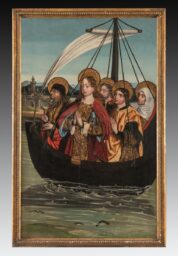
A woman called Mariamne, or Maria Magdala was referred to in several texts evangelising, breaking the communion bread, exorcising, and baptising.
There is textual evidence of a woman baptising in the ‘Acts of Philip’, where Mariamne performs baptisms alongside Philip: “Philip baptised the men and Mariamne the women.” This shows that at least in some early Christian imagination, women could hold sacramental authority, including baptism.
Considering what we know from the legends of France Mariamne, or Maria Magdala may have been alternative names for Mary Magdalene. (For more on this read my blog: ‘The Woman Who Knew the All’).
This image of Mary Magdalene on the way to Marseille is from the Castilian school, late fifteenth century.
The most compelling evidence for Mary Magdalene performing baptisms exists in Gaul, the south of France, where legend tells us she spent her final thirty years preaching (for more read my blog: ‘Mary Magdalene in Gaul’).
When we move into the traditions of southern France, the legends of Mary Magdalene in Provence associating her with water are medieval developments, emerging many centuries after the first century. They are rich, specific, and deeply rooted in place, but they are not contemporary historical records.
 In France, the local legends are rich with specific sites used by Mary Magdalene to baptise people. Rather than baptising inside a building, it seems Mary Magdalene continued Jesus’ tradition of using living (running) water, baptising in natural pools.
Local legend has it that Mary Magdalene conducted baptism rituals in the natural sacred pools, living water, throughout the South of France. These include Gorges des Gouleyrous, Gorges du Verdouble, Gorges de Termes, Cascade des Mathieux, Fontaine des Amours, Gorges des Galamus and Source d’Eau de Notre-Dame du Cros.
Here we have a painting of ‘Preche de la Madeleine in Marseilles’ from 1515.
According to ‘The Magdalene Legacy’ Laurence Gardner tells us that in Languedoc tradition, Mary Magdalene is remembered as la Dompna del Aquae, meaning the Lady of the Waters. The Gnostics and the Celts venerated women and associated them with lakes, wells, fountains and springs.
Titles like “Lady of the Waters” and the association with springs and baptismal sites reflect something meaningful. Although not a historical itinerary, they offer symbolic continuity. Water remains the thread.
Across very different layers of Gnostic texts, apocryphal acts, later European legend, the same pattern persists. A woman named Mary or Mariamne associated with teaching, initiation water, and authority that challenges expectation. But historically, we have to hold the distinctions.
Early Christian and Gnostic texts preserve the idea of a woman, most clearly Mary Magdalene, who held authority as a teacher and interpreter. Later traditions expand that role, even placing her in explicitly active sacramental positions that includes baptism. This woman was at the centre of initiation, associated with water, with knowledge, and transformation. The pattern of water, initiation, a woman who teaches and baptises remains.
2. Chrism (anointing)
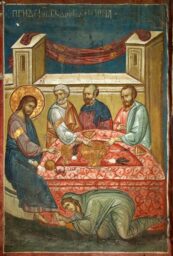 Chrism is a mixture of olive oil and balsam, an aromatic resin, used in sacraments like baptism, confirmation, and the ordination of priests. The balsam is added to give the oil a fragrant scent, symbolizing the “odour of sanctity” to which those marked with Chrism are called.
Anointing with Chrism signifies the full diffusion of grace and the gift of the Holy Spirit. It’s a powerful symbol of spiritual anointing and consecration. This anointing ritual is associated directly with Mary Magdalene and may have been a core practice of Mary Magdalene that Jesus included in his own initiations.
In ‘Mary Magdalene: A Biography’ historian Bill Chilton believes that anointing was something that Mary Magdalene taught Jesus, as she came from Galilee, a region where healing and shamanic arts were well known. (for more read my blog: ‘Mary Magdalene, the Anointrix’).
This fresco of Christ in the House of Simon is from the mid-fourteenth century in the Decani Monastery, Serbia.
3. Eucharist
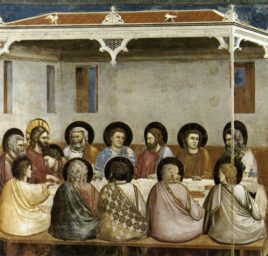 The Eucharist (in Greek eucharistia meaning thanksgiving), also known as Holy Communion, is a sacred meal instituted by Jesus Christ at the Last Supper, the night before his crucifixion.
Passages in the New Testament state that Jesus asked them to “do this in memory of me” while referring to the bread as “my body” and the cup of wine as “the blood of my covenant, which is poured out for many”.
I cannot find references to Mary Magdalene performing a Eucharist rite. Perhaps the lack of evidence is because she didn’t. Or perhaps the records were lost with the rest of her ministry in France (for more read my blog: ‘Mary Magdalene in Gaul’).
This fresco is by Giotto di Bondone from his ‘Scenes from the Life of Christ- the Last Supper’ from between 1304-1306, in the Scrovegni Chapel (Arena Chapel) in Padua, Italy.
4. Restoration to Fullness of Being
 In the Gnostic ‘Gospel of Philip’, the “restoration to fullness of being” is understood as spiritual transformation through mystical initiation, especially the bridal chamber ritual.
I cannot find references to Mary Magdalene preaching about the restoration to fullness of being or performing initiations to help attain this state. That’s probably because her sermons were all destroyed in the only Crusade against Christians, known as the Albigensian Crusade in the thirteenth century. This was a genocide against the Cathar Christian sect of Languedoc, the south-eastern region of France.
The restoration to fullness of being is such an integral teaching to Jesus’ five sacraments it feels impossible this was not part of Mary Magdalene’s teachings.Restoration to fullness of being true means accessing our spiritual knowledge (gnosis), which enables union with the divine and one’s higher self. Believers are seen as undergoing a process of becoming reconstituted or transformed, achieving a perfected, spiritual existence.
This is from a manuscript decoration XVº from ‘Speculum historiale’ ‘The Mirror of History’ by Vincent of Beauvais (c.1184/1194 – c.1264) a Dominican friar at the Cistercian monastery of Royamont Abbey, France.
Stripped of all that no longer serves, the individual is restored to “fullness of being”. Fullness of being was not a temporary ecstatic state created by a mystery ritual. It was a state of being explored through life’s trials and tribulations that leads to purification.
The perspective shifts from duality to co-creation with the will of God and the final transformation into non-dual consciousness becomes possible. The restoration involves transcending worldly dualities, such as the separation of male and female, to achieve a greater unity. The process aims to free initiates from demonic influences and the “rulers” who bind people to the physical world through deception and false names.
The transformed state involves clothing oneself in a “body of light” and living a spiritual existence rather than a material one. The restored individual is seen as a child of the “perfect human” who is continually born into a spiritual existence, in contrast to the dying children of Adam.
 First the initiate needed to “flee the divisions and the fetters” of the material world to access a higher consciousness. The initiates would have completed a series of challenges that proved they were ready for the next initiations to deepen their learning. These initiations were designed to accelerate their spiritual development through epiphanies and visions that lead to life-changing shifts in perception.
These initiations brought the initiate into mystical knowledge of God’s light and God’s unity within their own body temple. The spirit within each person was a “spinther” or spark of Ineffable God. These initiations were aimed at awakening those who had separated from this knowledge.
When an initiate received this illumination and realised they were really sparks of the divine they could see themselves as “living spirits”, Sons and Daughters of God, who no longer needed to “dwell in poverty”. This gave them the potential to see themselves as a Christ, as Christ consciousness.
It is perhaps this teaching that Mary Magdalene offered initiates in caves, scattered throughout the Languedoc region (for more read my blog: ‘Mary Magdalene in Gaul’).
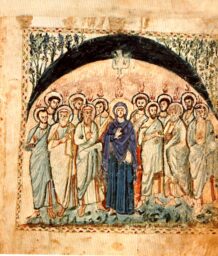
This Pentecost image is from the sixth century with Mary, the apostles and the Holy Spirit represented as a dove from the Rabula Gospels Folio (Florence, Biblioteca Mediceo Laurenziana, cod. Plut. I, 560 CE).
5. The Bridal Chamber
 In the ‘Gospel of Philip’ the bridal chamber rite was the highest level of initiation and a ritual that remains shrouded in mystery and misunderstanding. The ultimate goal is a spiritual union with God and the divine realm, escaping the constraints of the physical world.
The ‘Gospel of Philip’ makes it clear that the bridal chamber does not confer the state of oneness. The initiate must already be integrated into this state to be admitted into the holiest inner sanctum to experience “the sacred embrace”.
In the ‘Dialogue of The Savour’, Jesus mentions the bridal chamber: “The Lord said, ‘It is you who will rule over them! But when you rid yourselves of jealousy, then you will clothe yourselves in light and enter the bridal chamber.’ Judas said, ‘How will our garments be brought to us?’ The Lord said, ‘There are some who will provide for you, and there are others who will receive […]. For it is they who will give you your garments. For who will be able to reach that place which is the reward? But the garments of life were given to man because he knows the path by which he will leave. And it is difficult even for me to reach it!’”
This contemporary painting is called ‘The Beloveds’ by Cheryl Yambrach Rose.
 The Bridal Chamber was an act of the deepest surrender, a sacred union of equals meeting in an intimate act of greatest vulnerability. “Sacred beings are entirely holy, including their bodies.” (Gospel of Philip analogue 60).
Gnosis is not offered or encouraged through direct experience. The orthodox Church preached second hand gnosis, or worse. This is the divine feminine and divine masculine united in sacred union.
The unification of the soul with the physical, mental, and emotional body through the intelligence centre of the heart. This was the same path of Gnosis that John the Baptist, Jesus, Mary Magdalene, the Buddha and many of the others have walked.
Detail of the fresco ‘Mary Magdalene and Jesus by Giotto di Bondone, Scrovegni Chapel, Padua.
The bridal chamber was clearly the highest level of initiation and a ritual that remains shrouded in mystery and misunderstanding. The bridal chamber is situated at the very centre of the innermost and most holy and hidden place. The ‘Gospel of Philip’ uses the bridal chamber as a metaphor for reunification, a merging and reuniting from separation to union. This is exemplified by the sacred union of Jesus and Mary Magdalene.
In his book on ‘The Gospel of Philip’, Jean-Yves Leloup asks “What is the bridal chamber, if not the place of trust and consciousness in the embrace? It is an icon of Union, beyond all forms of possession; here is where the veil is torn from top to bottom; here is where some arise and awaken. The powers can do nothing against those who are clothed in the light; they cannot see them. All will be clothed in light when they enter the mystery of the sacred embrace.
The teachings of Jesus did not come from nowhere. The Five Sacraments of Jesus originated in ceremonies and initiations that had existed in Mesopotamia, Egypt, the Levant fand around the Mediterranean for thousands of years.
The fifth sacrament of Jesus, known as the Bridal Chamber sounds remarkably similar to the ancient Sumerian sacred marriage rituals, where during the New Year’s festival the god and goddess or their human substitutes would enter the bedchamber as bride and groom for a ritual of sacred sexual love making. This is ancient wisdom, continued by the ancient goddess-worshipping people of Egypt and Mesopotamia. (For more read my blog: ‘Before Spirituality Split from Sexuality’).
Featured Image: ‘Appearance on the Mountain in Galilee’ by Duccio di Buoninsegna, 1308- 1311, in the Collection Museo dell’Opera Metropolitana del Duomo.